Showing posts with label Difficult Quantitative Aptitude Questions for IBPS. Show all posts

Monday, 10 July 2017


Practice is the key to perfection in Quant, so brush up your skills and test yourself with these 15 questions of Quantitative Aptitude for IBPS EXAM 2017.

Directions (1-5): In each of these questions, a question is followed by information given in three statements. You have to study the question along with information given in the statements and decide the information in which of the statement(s) is/are necessary and sufficient to answer the question.

Q1. In how many days can the work be completed by A, B and C together? 

(I) A and B together can complete the work in 6 days. 
(II) B and C together can complete the work in 15/4 days. 
(III) A and C together can complete the work in 10/3 days. 
(a) Only I 
(b) Only II 
(c) Only III
(d) Any one of the three 
(e) All the three statements are necessary to answer the question. 

Q2. What is the cost of painting the two adjacent walls of a hall which has no windows or doors? 
(I) The area of the hall is 24 sq. metres. 
(II) The breadth, length and the height of the hall are in the ratio of 4 : 6 : 5 respectively.
(III) Area of one wall is 30 square metres. 
(a) Only I 
(b) Only II 
(c) Only III
(d) Either I or III 
(e) Data inadequate 

Q3. What is the total compound interest earned at the end of the three years? 
(I) Simple interest earned on that amount at the same rate and period is Rs. 4,500
(II) The rate of interest is 10 percent per annum 
(III) Compound interest for three years is more than the simple interest for that period by Rs. 465. 
(a) Only I and II 
(b) Only II and III
(c) Only I and III
(d) Any two of the three 
(e) Either II or III only 

Q4. What is the percent profit earned by the shopkeeper on selling the articles in his shop? 
(I) Labelled price of the articles sold was 130% of the cost price. 
(II) Cost price of each article was Rs. 550. 
(III) A discount of 10% on labelled price was offered. 
(a) Only I and III
(b) Only II 
(c) Only III
(d) Only II and III
(e) Questions cannot be answered even with the information given in all the three statements. 

Q5. What is the average salary of 15 employees?
(I) Average salary of 7 Clerical cadre (out of the 15 employees) employees is Rs. 8,500. 
(II) Average salary of 5 officer cadre (out of the 15 employees) employees is Rs. 10,000. 
(III) Average salary of remaining 3 employees (out of the 15 employees) is Rs. 2,500.  
(a) None 
(b) Only I 
(c) Only II 
(d) Only III 
(e) All the three statements are necessary to answer the question  

Directions (6-10): Each of the questions below consists of a question and two statements numbered I and II given below it. You have to decide whether the data provided in the statements are sufficient to answer the question. Read the question and both the statements and

Give answer (a) if the data in statement I alone are sufficient to answer the question, while the data in statement II alone are not sufficient to answer the question. 
Give answer (b) if the data in statement II alone are sufficient to answer the question, while the data in statement I alone are not sufficient to answer the question. 
Give answer (c) if the data either in statement I alone or in statement II alone are sufficient to answer the question. 
Give answer (d) if the data even in both the statements I and II together are not sufficient to answer the question. 
Give answer (e) if the data in both the statements I and II together are necessary to answer the question. 

Q6. Train ‘A’ running at a certain speed crosses another train ‘B’ running at a certain speed in the opposite direction in 12 seconds. What is the length of train ‘B’? 
I. The length of both the trains together is 450 metres. 
II. Train ‘A’ is slower than train ‘B’. 

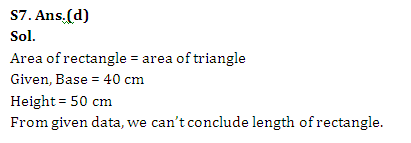
Q7. Area of a rectangle is equal to the area of a right angled triangle. What is the length of the rectangle? 
I. The base of the triangle is 40 cms. 
II. The height of the triangle is 50 cms. 
Q8. What was the total compound interest on a sum after three years? 
I. The interest after one year was Rs. 100/- and the sum was Rs. 1,000/-. 
II. The difference between simple and compound interest on a sum of Rs. 1,000/- at the end of two years was Rs. 10/-. 

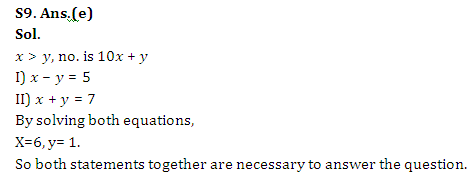
Q9. What is the two digit number where the digit at the unit place is smaller? 
I. The difference between the two digits is 5. 
II. The sum of the two digits is 7. 
Q10. What is the speed of the boat in still water? 
I. It takes 2 hours to cover distance between A and B down streams. 
II. It takes 4 hours to cover distance between A and B up streams. 

Directions (11-15): In the following questions two equations numbered I and II are given. You have to solve both the equations and 
Give answer (a) if x > y 
Give answer (b) if x ≥ y 
Give answer (c) if x < y
Give answer (d) if x ≤ y 
Give answer (e) if x = y or the relationship cannot be established. 

Solutions (11-15):


Sunday, 9 July 2017


Practice is the key to perfection in Quant, so brush up your skills and test yourself with these 15 questions of Quantitative Aptitude for IBPS EXAM 2017.

Directions (1-4): In each of the following questions, a question is followed by information given in three statements. You have to study the question along with the statements and decide the information given in which of the statement(s) is necessary and sufficient to answer the question.

Q1. What is the average weight of girls in the class?
I. Average weight of all the 60 students is 42 kg.
II. Average weight of boys is 43 kg
III. Total weight of all girls together is 1144 kg
(a) Any two of three
(b) All I, II & III
(c) I & II only
(d) II & III only
(e) Question cannot be answered even with information in all three statements.


Q2. What is the selling price of the T.V. set if no discount is offered?
I. Profit earned was 20%
II. Had 10% discount been offered on selling price the profit would have been Rs. 1200.
III. Cost price is Rs. 15000.
(a) Any two of the three
(b) Only I & II
(c) Only I I& III
(d) Only II & III
(e) None of these


Q3. What is the speed of the train?
I. Length of the platform is 150% of the length of the train.
II. The train crosses the platform in 25 seconds.
III. The train crosses the signal pole in 19 seconds.
(a) All I, II & III
(b) I and Either II or III
(c) Only II & III
(d) Any two of the three
(e) Question cannot be answered even with the information in all three statements.

S3. Ans.(e)
Sol. ∵ Length of platform or train is not given.
So, we can’t answer the question with the information given.

Q4. What is the volume of the cylindrical tank?
I. Area of the base is X square metres.
II. Height of the tank is Y metres.
III. Diameter of the base is equal to height of the tank.
(a) Only I & II
(b) Only II & III
(c) Only I & III
(d) All I, II & III
(e) Any two of the three

S4. Ans.(e)
Sol. To get volume of cylinder, we need height and radius.
So, from any two of three statement, we can get answer.

Q5. Out of 5 women and 4 men a committee of three members is to be formed in such a way that at least one member is a women. In how many different ways can it be done?
(a) 80
(b) 84
(c) 76
(d) 96
(e) None of these


Q6. Arrange the letters of word AUCTION in such a way that the vowels always occur together. Find the number of ways?
(a) 576
(b) 48
(c) 144
(d) 30
(e) None of these


Q7. Two girls and 4 boys are to be seated in a row in such a way that the girls do no sit together. In how many different ways can it be done?
(a) 720
(b) 480
(c) 360
(d) 240
(e) None of these

S7. Ans.(b)
Sol. Total possible arrangement = (2+4)!=6!=720
When two girls sit together,
2!×5!=240

Q8. In how many different ways can the numbers ‘256974’ be arranged, using each digit only once in each arrangement, such that the digits 6 and 5 are at the extreme ends in each arrangement?
(a) 48
(b) 720
(c) 36
(d) 360
(e) None of these


Q9. A basket contains 6 red, 5 green and 8 blue balls. If four balls are picked at random, what is the probability that all four of them are either red or any two out of the four are green?


Q10. A bag contains 2 red, 3 green and 2 blue balls. 2 balls are to be drawn randomly. What is the probability that the balls drawn contain no blue ball?


Q11. In a container there are 28 eggs out of which 8 eggs are rotten. If two eggs are chosen at random, what will be the probability that atleast one egg is rotten?


Q12. A box contains 4 black balls, 3 red balls and 5 green balls. 2 balls are drawn from the box at random. What is the probability that both the balls are of the same colour?


Directions (13-15): What should come in place of the question mark (?) in the following number series?
Q13. 586,    587,    586,    581,    570,     ?,      522
(a) 545
(b) 543
(c) 551
(d) 557
(e) None of these


Q14. 4000,    2008,    1012,    ?,    265,    140.5,    78.25
(a) 506
(b) 514
(c) 520
(d) 512
(e) None of these


Q15. 50,    60,     75,      97.5,    ?,     184.275,     267.19875
(a) 120.50
(b) 130.50
(c) 131.625
(d) 124.25
(e) None of these

Friday, 7 July 2017


Practice is the key to perfection in Quant, so brush up your skills and test yourself with these 15 questions of Twisted Ones Quantitative Aptitude for IBPS PO EXAM 2017.

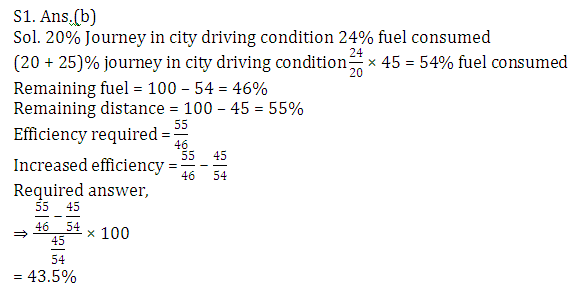
Q1. Samuel, a motorist uses 24% of his fuel in covering the first 20% of his total journey (in city driving conditions). If he knows that he has to cover another 25% of his total journey in city driving conditions, what should be the minimum percentage increase in the fuel efficiency for non-city driving over the city driving fuel efficiency, so that he is just able to cover his entire journey without having to refuel? (Approximately)
(a) 39.2%
(b) 43.5%
(c) 45.6%
(d) 41.2%
(e) None of these

Q2. A 14.4 kg gas cylinder runs for 104 hours when the smaller burner on the gas stove is fully opened while it runs for 80 hours when the larger burner on the gas stove is fully opened. Difference in the usage of gas per hour, between the smaller and the larger burner is what percent of the usage per hour of larger burner?
(a) 26.23%
(b) 30%
(c) 32.23%
(d) 23.07%
(e) None of these

Q3. Two people A and B start moving from P and Q that are 200 km apart, towards each other A is on a moped and B on foot. They meet at a point R when A gives B a lift to P and returns to his original path to reach Q. On reaching Q he finds that he has taken 2.6 times his normal time. B on the other hand realizes that he has saved 40 minutes over his normal travel time. Find the ratio of their speeds.
(a) 3 : 2
(b) 4 : 3
(c) 3 : 1
(d) None of these
(e) 4 : 1

Q4. A cyclist left point A for point B and travelled at the constant speed of 25 km/h. When he covered the distance of 8.33 km, he was overtaken by a car that left point A twelve minutes after the cyclist and travelled at a constant speed too. When the cyclist travelled another 30 km, he encountered the car returning from B. Assume that the car did not stop at point B. Find the distance between A and B.
(a) 39.5833 km
(b) 41.0833 km
(c) 60.833 km
(d) 43.33 km
(e) None of these

Q5. 4 men and 16 women can complete piece of work in 10 days. 10 children and 12 women can complete the same work in 12 days. 5 children and 6 men can complete the same work in 15 days. Then in how many days will thrice the work can be completed by 6 men, 8 women and 20 children?
(a) 16 days
(b) 24 days
(c) 32 days
(d) 20 days
(e) None of these

Q6. Two friends bought 2 different land at a price of 4000 and 6000 respectively. The value of first land increases 25% per year and second land increases at 5% per year. At the end of two year they exchange the land. Find profit % of gainer after exchange.
(a) 6.12%
(b) 5.84%
(c) 5.46%
(d) 6.24%
(e) None of these

Q7. On an average, two liters of milk and one liter of water are needed to be mixed to make 1 kg of Milk Shake of type A, and 3 litres of milk and 2 litres of water are needed to be mixed to make 1 kg of Milk Shake of type B. How many kilograms of each type of Milk Shake was manufactured if it is known that 130 liters of milk and 80 liters of water were used?
(a) 20 of type A and 30 of type B
(b) 30 of type A and 20 of type B
(c) 15 of type A and 30 of type B
(d) 30 of type A and 15 of type B
(e) None of these
Q8. A certain number of trucks were required to transport 60 tons of steel wire from the TISCO factory in Jamshedpur. However, it was found that since each truck could take 0.5 tons of cargo less, another 4 trucks were needed. How many trucks were initially planned to be used?
(a) 10
(b) 15
(c) 20
(d) 25
(e) 24
Q9. A fill pipe can fill a tank in 20 hours, a drain pipe can drain a tank in 30 hours. If a system of n pipes (fill pipes and drain pipes put together) can fill the tank in exactly 5 hours, which of the following are possible values of n (More than one option could be correct)?
(1)    32       (2)    54       (3)    29       (4)    40
(a) 1 and 2 only
(b) 1 and 3 only
(c) 2 and 4 only
(d) 2 and 3 only
(e) None of these

Q10. A car driver, driving in a fog, passes a pedestrian who was walking at the rate of 2 Km/h in the same direction. The pedestrian could see car for 6 minutes and it was visible to him up to a distance of 0.6  km. What was the speed of the car? 
(a) 15 Km/h 
(b) 30 Km/h 
(c) 20 Km/h 
(d) 8 Km/h 
(e) None of these

Q11. Manish, Rahul and Bharti have some stones with each of the. Five times the number of stones with Rahul equals seven times the number of stones with Manish while five times the number of stones with Manish equals seven times the number of stones withBharti. What is the minimum number of stones that can be there with all three of them put together?
(a) 113
(b) 109
(c) 93
(d) 97
(e) None of these

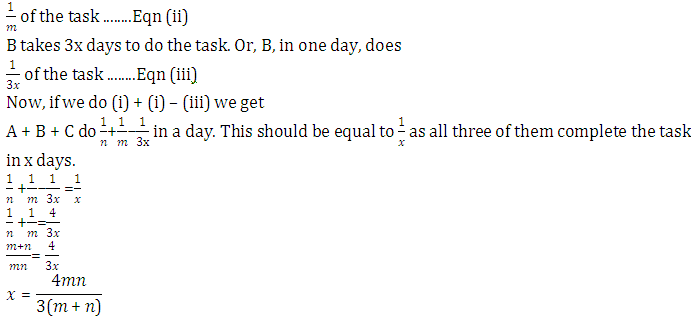
Q12. Consider three friends A, B and C who work at différent speeds. When the slowest two work together they take n days to finish a task. When the quickest two work together they take m days to finish a task. One of them, if he worked alone would take thrice as much time as it would take when all three work together. How much time would it take if all three worked together?


Q13. A shopkeeper defrauds both the dealer and the customer by measuring weights incorrectly. When he is purchasing items from the dealer, he takes 20% more then the indicated weight and when he is selling them to the customer, he gives 20% less than the indicated weight.If the price that the shopkeeper charges his customer is the same as what the dealer charges the shopkeeper, then what profit percentage does the shopkeeper make? 
(a) 50%
(b) 30%
(c) 40%
(d) 60%
(e) None of these 

Q14. A and B enters into a partnership business with a capital of Rs. 20000 and Rs. 30000 respectively. They decided to share the profit in ratio as per capital invested but in the end of 1st year they divided the profit in 3 equal parts and both A and B take 1 part individually. Rest of the profit is lend to C for a year at an interest rate of 50/3% Per year. At the end of 2nd year A received Rs 7000 from C then find the total profit at the end of 1st year.
(a) 84000
(b) 90000
(c) 60000
(d) 78000
(e) None of these

Q15. The Maximum Retail Price (MRP) of a product is 55% above its manufacturing cost. The product is sold through a retailer, who earns 23% profit on his purchase price. What is the profit percentage (expressed in nearest integer) for the manufacturer who sells his product to the retailer? The retailer gives 10% discount on MRP.
(a) 31%
(b) 22%
(c) 15%
(d) 13%
(e) 11%


Popular Posts