Showing posts with label RBI Grade-B Phase-1 Exam. Show all posts

Saturday, 17 June 2017


Dear Aspirants, The Most awaited RBI Grade-B 2017 Phase-1 exam is over, Now it's time for exam analysis of RBI Grade-B 2017 Phase-1 (17th June 2017), Shift-2. A lot of students have appeared for their mains exam today and this brings them to a step closer in their journey of getting a Job in Banking Sector. Without wasting any moment, let's get straight to the analysis For which you are all waiting for. The overall exam was moderate to difficult. 

There are 4 Sections in RBI Grade-B 2017 Phase-1 exam namely English, Reasoning, General Awareness and Quantitative Aptitude.


RBI GRADE-B 2017 PHASE-1 EXAM ANALYSIS (OVER-ALL):

SECTIONSGOOD ATTEMPTS
ENGLISH LANGUAGE10-12
REASONING ABILITY31-34
QUANTITATIVE APTITUDE9-11
GENERAL AWARENESS38-41
TOTAL87-94


QUANTITATIVE APTITUDE (Difficult)

The level of quantitative aptitude was difficult. There were three sets of DI one form Line Graph (With Missing DI) another one based on double pie chart and the third one was caselet DI.

The questions were:

TopicNo. of QuestionsLevel
Inequalities (New Pattern)5Difficult
Data Interpretation (Double Pie Chart and Line graph with missing DI)15Difficult
Miscellaneous(SI,CI, Speed &Time, Profit and Loss, Time and Work, Averages, Ages, Ratio etc.)10Difficult
Total30Difficult

ENGLISH LANGUAGE (Difficult)

The level of English was Difficult. There were two set of RC in which one was based on new pattern(that came in SBI PO mains) and another one was based on old pattern.

Topics of Reading Comprehension:
  • Valuation of currency (USD)
  • European Central Bank. 

TopicNo. of QuestionsLevel
Reading Comprehension 12Moderate-Difficult
Double fillers5Moderate
Idioms and Phrases 3Difficult
Sentence Correction 5Difficult
Total30Difficult

REASONING ABILITY (
Moderate-Difficult)

The level of reasoning was moderate - Difficult. There were 4 puzzles and sitting Arrangement based on following pattern:-

  • Linear North- South 
  • Students and class (Odd Even)
  • Month based Puzzle
  • Floor based Puzzle with salary.

The questions were:

TopicNo. of QuestionsLevel
Data Sufficiency5Moderate
Input - Output6Difficult
Logical Reasoning11Moderate
Blood Relation3Moderate
Sitting Arrangement and Puzzles (Linear, Circular, and Floor)20Moderate-Difficult
Inequality5Moderate
Syllogism7Moderate
 Direction3Moderate
Total60Moderate

GENERAL AWARENESS (Moderate)

General Awareness had 80 questions for 80 marks. This section is moderate for those who knows banking terms. Most of the current affairs questions were asked from Our GK POWER Capsule. Our Capsule is the first and last resource to all banking aspirants in India. The questions were mainly asked from banking and  recently Current affairs (May and June). No questions were asked from budget and economy survey. Some questions were from static.


Dear Aspirants, The Most awaited RBI Grade-B 2017 Phase-1 exam is over, Now it's time for exam analysis of RBI Grade-B 2017 Phase-1 (17th June 2017). A lot of students have appeared for their mains exam today and this brings them to a step closer in their journey of getting a Job in Banking Sector. Without wasting any moment, let's get straight to the analysis For which you are all waiting for. The overall exam was moderate to difficult. 

There are 4 Sections in RBI Grade-B 2017 Phase-1 exam namely English, Reasoning, General Awareness and Quantitative Aptitude.


RBI GRADE-B 2017 PHASE-1 EXAM ANALYSIS (OVER-ALL):

SECTIONSGOOD ATTEMPTS
ENGLISH LANGUAGE11-13
REASONING ABILITY33-36
QUANTITATIVE APTITUDE9-12
GENERAL AWARENESS39-43
TOTAL89-97


QUANTITATIVE APTITUDE (Difficult)

The level of quantitative aptitude was difficult. There were three sets of DI one form time and work another one based on double pie chart and the third one was based on water and tank

The questions were:

TopicNo. of QuestionsLevel
Inequalities (New Pattern)5Difficult
Data Interpretation (Tabular and Bar graph)15Difficult
Miscellaneous(SI,CI, Speed &Time, Profit and Loss, Time and Work, Averages, Ages, Ratio etc.)10Difficult
Total30Difficult

ENGLISH LANGUAGE (Difficult)

The level of English was Difficult. There were two set of RC in which one was based on new pattern(that came in SBI PO mains) and another one was based on old pattern.

Topics of Reading Comprehension:
  • Banking System in Britain.
  • European countries and their currencies(Euro) 

TopicNo. of QuestionsLevel
Reading Comprehension 12Moderate-Difficult
Double fillers5Moderate
Idioms and Phrases 3Difficult
Sentence Correction 5Difficult
Total30Difficult

REASONING ABILITY (
Moderate-Difficult)

The level of reasoning was moderate - Difficult. There were 4 puzzles and sitting Arrangement based on following pattern:-

  • Linear North- South 
  • Students and class (Odd Even)
  • Month based Puzzle
  • Floor based Puzzle with salary.

The questions were:

TopicNo. of QuestionsLevel
Data Sufficiency5Moderate
Input - Output6Difficult
Logical Reasoning11Moderate
Blood Relation3Moderate
Sitting Arrangement and Puzzles (Linear, Circular, and Floor)20Moderate-Difficult
Inequality5Moderate
Syllogism7Moderate
 Direction3Moderate
Total60Moderate

GENERAL AWARENESS (Moderate)

General Awareness had 80 questions for 80 marks. This section is moderate for those who knows banking terms. Most of the current affairs questions were asked from Our GK POWER Capsule. Our Capsule is the first and last resource to all banking aspirants in India. The questions were mainly asked from banking and  recently Current affairs (May and June). No questions were asked from budget and economy survey. Some questions were from static.

Wednesday, 14 June 2017


Practice is the key to perfection in Quant, so brush up your skills and test yourself with these 15 questions of Quantitative Aptitude for RBI Grade-B 2017.

Directions (Q.1-5): In the following number series, only one number is wrong. Find out the wrong number.

Q1. 336, 210, 120, 62, 24, 6, 0 
(a) 120 
(b) 62
(c) 24
(d) 6
(e) None of these


Q2. 5, 3, 6, 10, 9, 12, 17, 15, 18, 23
(a) 10 
(b) 9
(c) 12
(d) 17
(e) None of these

Q3. 0, 3, 8, 15, 27, 35, 48 
(a) 0 
(b) 3
(c) 8
(d) 15
(e) None of these

Q4. 8, 14, 26, 48, 98, 194 
(a) 14
(b) 26
(c) 48
(d) 95
(e) None of these

Q5. 12, 32, 72, 152, 314, 632
(a) 32
(b) 72
(c) 152
(d) 314
(e) None of these

Q6. A railway half ticket costs half the full fare. But the reservation charged on half ticket is the same as that on full ticket. One reserved first class ticket for a journey between two stations is Rs. 525 and the cost of one full and one half reserved first class tickets is Rs. 850. What is the reservation charge?
(a) Rs. 125
(b) Rs. 200 
(c) Rs. 145 
(d) Can’t be determined 
(e) None of these

Q7. Manish borrowed a sum of Rs. 1150 from Anil at the simple rate of 6% per annum for 3 yr. Then, he added some more money the borrowed sum and lent it to Sunil for the same time at 9% per annum at simple interest. If Manish gains Rs. 274.95 by way of interest on borrowed sum as well as his own amount from the whole transactions, then what is the sum lent by him to Sunil? 
(a) Rs. 1290
(b) Rs. 1785 
(c) Rs. 1285 
(d) Rs. 1200 
(e) None of these

Q8. While packing for a business trip Mr. Debashis has packed 3 pairs of shoes, 4 pants, 3 half-pants, 6 shirts, 3 sweater and 2 jackets. The outfit is defined as consisting of a pair of shoes, a choice of ‘lower wear’ (either a pant or a half-pant), a choice of ‘upper wear’ (it could be a shirt or a sweater or both) and finally he may or may not choose to wear a jacket. How many different outfits are possible?
(a) 567
(b) 1821
(c) 743
(d) 894
(e) None of these

Q9. The sum of five consecutive even numbers of set A is 280. What is the sum of different set B of five consecutive numbers whose lowest number is 71 less than double the lowest number of set A? 
(a) 182
(b) 165
(c) 172
(d) 175
(e) None of the above 

Q10. The number obtained by interchanging the two digits of a two digit number is lesser than the original number by 54. If the sum of the two digits of the number is 12, then what is the original number?
(a) 28
(b) 39
(c) 82
(d) Can’t be determined 
(e) None of the above 

Directions (Q.11-15): What will come in place of the question-mark (?) in the following questions?


Tuesday, 13 June 2017


Practice is the key to perfection in Quant, so brush up your skills and test yourself with these 15 questions of Quantitative Aptitude for RBI Grade-B 2017.

Q1. The ratio between the number of passengers travelling by I and II classes between the two railway stations is 1 : 50, whereas the ratio of I and II classes fares between the same stations is 3 : 1. If on a particular day, Rs. 1325 were collected from the passengers travelling between these stations, then what was the amount collected from the II class passengers?
(a) Rs. 750 
(b) Rs. 1000
(c) Rs. 850 
(d) Rs. 1250 
(e) None of these

Q2. In a co-educational school there are 15 more girls than boys. If the number of girls is increased by 10% and the number of boys is also increased by 16% there would be nine more girls than boys. What is the number of students in the school?
(a) 140
(b) 125
(c) 265
(d) 255
(e) None of these

Q3. The average monthly salary of employees, consisting of officers and workers of an organization is Rs. 3000. The average salary of an officer is Rs. 10000 while that of a worker is Rs. 2000 per month. If there are total 400 employees in the organization, find the number of officers and workers separately. 
(a) 50, 350
(b) 350, 50 
(c) 250, 150
(d) 150, 250
(e) None of these

Q4. Mr. Pandit owned 950 gold coins all of which he distributed amongst his three daughters Lalita, Amita and Neeta. Lalita gave 25 gold coins to her husband, Amita donated 15 gold coins and Neeta made jewellery out of 30 gold coins. The new respective ratio of the coins left with them was 20 : 73 : 83. How many gold coins did Amita receive from Mr. Pandit?
(a) 380
(b) 415
(c) 400
(d) 350
(e) None of these


Q5. One of the angles of a quadrilateral is thrice the smaller angle of a parallelogram. The respective ratio between the adjacent angles of the parallelogram is 4 : 5. Remaining three angles of the quadrilateral are in the ratio 4 : 11 : 9 respectively. What is the sum of the largest and the smallest angles of the quadrilateral?
(a) 255°
(b) 260°
(c) 265°
(d) 270°
(e) None of these

Q6. Vijay purchased two different kinds of alcohol. In the first mixture the ratio of alcohol to water is 3 : 4 and in the second mixture it is 5 : 6. If he mixes the two given mixture and makes a third mixture of 18 litres in which the ratio of alcohol to water is 4 : 5, the quantity of the first mixture (whose ratio is 3 : 4) that is required to make 18 litres of the third kind of mixture is 
(a) 6
(b) 7
(c) 8
(d) 9
(e) None of these

Q7. Three partners invested capital in the ratio 2 : 7 : 9. The time period for which each of them invested was in the ratio of the reciprocals of the amount invested. Find the share of  profit of the partner who brought in the highest capital, If profit is Rs. 1080. 
(a) Rs. 120 
(b) Rs. 360 
(c) Rs. 540 
(d) Rs. 420 
(e) None of these

Q8. A vendor sells calculators at the rate of Rs. 250 each and earns a commission of 20% on each. He also sells pens at the rate of Rs. 50 each and earns a commission of 10% on each. How much amount of commission will he earn in three days if he sells 10 calculators and 5 pens a day?
(a)Rs. 1,575
(b)Rs. 1,445
(c)Rs. 1,550 
(d)Rs. 1,450 
(e) None of these

Q9. A sum of Rs. 30600 is divided between Anjali and Arun, who are respectively 18 and 19 yr old, in such a way that if their shares are invested at 4% per annum compounded annually, they shall receive the same amount on reaching 21 yr of age. What is the share of Anjali?
(a) Rs. 16000
(b) Rs. 15000 
(c) Rs. 15600
(d) Rs. 14600
(e) None of these

Q10. A journey of 192 km between two cities takes two hours less by a fast train than by a slow train. If the average speed of the slow train is 16 km/hr less than that of the fast train, then the average speed of the fast train is
(a) 36 km/hr
(b) 64 km/hr
(c) 7 km/hr
(d) 48 km/hr
(e) None of these

Directions (Q.11-15): What should come in the place of the question mark (?) in following number series problems?

Q11. 33, 39, 57, 87, 129, ?
(a) 183
(b) 177
(c) 189
(d) 199
(e) None of these

Q12. 19, 26, 40, 68, 124, ?
(a) 246
(b) 238
(c) 236
(d) 256
(e) None of these

Q13. 1,     3,     10,    48,    ?,    6432
(a) 208
(b) 380
(c) 400
(d) 360
(e) 440

Q14. 21, 23, 37, 71, 133, ?
(a) 321 
(b) 231
(c) 319 
(d) 237 
(e) 235

Q15. 36,     20,      ?,      8,     6,      5
(a) 10
(b) 12
(c) 14
(d) 16
(e) None of these

Monday, 12 June 2017


Practice is the key to perfection in Quant, so brush up your skills and test yourself with these 15 questions of Quantitative Aptitude for RBI Grade-B 2017.

Q1. A dealer sold a radio at a loss of 2.5%. Had he sold it for Rs 100 more, he would have gained 7.5%. For what value should he sell it in order to gain 12.5%?
(a) Rs. 1120
(b) Rs. 1150
(c) Rs. 1125
(d) Rs. 1225
(e) None of these

Q2. A man has whisky worth Rs. 22 a litre and another lot worth Rs 18 a litre. Equal quantities of these are mixed with water to obtain a mixture of 50 litres worth Rs 16 a litre. Find how much water the mixture contains?
(a) 5 litres
(b) 10 litres
(c) 15 litres
(d) 20 litres
(e) None of these

Q3. A alone would take 27 hours more to complete the job than if both A and B would together. If B worked alone, he took 3 hours more to complete the job than A and B worked together. What time, would they take if both A and B worked together?
(a) 8 hours
(b) 10 hours
(c) 9 hours
(d) 6 hours
(e) None of these

Q4. A train leaves the station 1 hour before the scheduled time. The driver decreases its speed by 50 km/hr. At the next station 300 km away, the train reached on time. Find the original speed of the train.
(a) 100 km/hr
(b) 150 km/hr
(c) 200 km/hr
(d) 180 km/hr
(e) None of these

Q5. The dimensions of a room are 12.5 metres by 9 metres by 7 metres. There are 2 doors and 4 windows in the room; each door measures 2.5 metres by 1.2 metres and each window 1.5 metres by 1 metre. Find the cost of painting the walls at Rs 3.50 per square metre.
(a) Rs 1011.50
(b) RS 1050.50
(c) Rs 1101.50
(d) Can’t be determined
(e) None of these

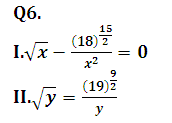
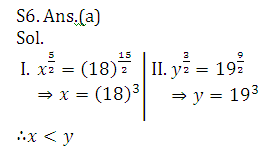
Directions (Q.6-10): Two equations I and II are given below in each question. You have to solve these equations and give answer 
(a) if x<y
(b) if x>y
(c) if x≤y
(d) if x≥y
(e) if x=y or no relation can be established


Directions (Q.11-15): Find out wrong number in following number series:

Q11. 1500, 1581, 1664, 1749, 1833, 1925, 2016
(a) 2016
(b) 1664
(c) 1833
(d) 1581
(e) 1925

Q12. 1, 5, 3, 17, 19, 67, 91
(a) 19
(b) 67
(c) 3
(d) 91
(e) 5

Q13. 655,  439,  314,  250,  233,  215
(a) 233
(b) 314
(c) 439
(d) 215
(e) 250

Q14. 582   605   588   611   634   617   600
(a) 634
(b) 611
(c) 605
(d) 600
(e) 582

Q15. 37   4752     67  87   112  142
(a) 47
(b) 52
(c) 67
(d) 87
(e) 112

Popular Posts