Sunday, 9 July 2017


Practice is the key to perfection in Quant, so brush up your skills and test yourself with these 15 questions of Quantitative Aptitude for IBPS EXAM 2017.

Directions (1-4): In each of the following questions, a question is followed by information given in three statements. You have to study the question along with the statements and decide the information given in which of the statement(s) is necessary and sufficient to answer the question.

Q1. What is the average weight of girls in the class?
I. Average weight of all the 60 students is 42 kg.
II. Average weight of boys is 43 kg
III. Total weight of all girls together is 1144 kg
(a) Any two of three
(b) All I, II & III
(c) I & II only
(d) II & III only
(e) Question cannot be answered even with information in all three statements.


Q2. What is the selling price of the T.V. set if no discount is offered?
I. Profit earned was 20%
II. Had 10% discount been offered on selling price the profit would have been Rs. 1200.
III. Cost price is Rs. 15000.
(a) Any two of the three
(b) Only I & II
(c) Only I I& III
(d) Only II & III
(e) None of these


Q3. What is the speed of the train?
I. Length of the platform is 150% of the length of the train.
II. The train crosses the platform in 25 seconds.
III. The train crosses the signal pole in 19 seconds.
(a) All I, II & III
(b) I and Either II or III
(c) Only II & III
(d) Any two of the three
(e) Question cannot be answered even with the information in all three statements.

S3. Ans.(e)
Sol. ∵ Length of platform or train is not given.
So, we can’t answer the question with the information given.

Q4. What is the volume of the cylindrical tank?
I. Area of the base is X square metres.
II. Height of the tank is Y metres.
III. Diameter of the base is equal to height of the tank.
(a) Only I & II
(b) Only II & III
(c) Only I & III
(d) All I, II & III
(e) Any two of the three

S4. Ans.(e)
Sol. To get volume of cylinder, we need height and radius.
So, from any two of three statement, we can get answer.

Q5. Out of 5 women and 4 men a committee of three members is to be formed in such a way that at least one member is a women. In how many different ways can it be done?
(a) 80
(b) 84
(c) 76
(d) 96
(e) None of these


Q6. Arrange the letters of word AUCTION in such a way that the vowels always occur together. Find the number of ways?
(a) 576
(b) 48
(c) 144
(d) 30
(e) None of these


Q7. Two girls and 4 boys are to be seated in a row in such a way that the girls do no sit together. In how many different ways can it be done?
(a) 720
(b) 480
(c) 360
(d) 240
(e) None of these

S7. Ans.(b)
Sol. Total possible arrangement = (2+4)!=6!=720
When two girls sit together,
2!×5!=240

Q8. In how many different ways can the numbers ‘256974’ be arranged, using each digit only once in each arrangement, such that the digits 6 and 5 are at the extreme ends in each arrangement?
(a) 48
(b) 720
(c) 36
(d) 360
(e) None of these


Q9. A basket contains 6 red, 5 green and 8 blue balls. If four balls are picked at random, what is the probability that all four of them are either red or any two out of the four are green?


Q10. A bag contains 2 red, 3 green and 2 blue balls. 2 balls are to be drawn randomly. What is the probability that the balls drawn contain no blue ball?


Q11. In a container there are 28 eggs out of which 8 eggs are rotten. If two eggs are chosen at random, what will be the probability that atleast one egg is rotten?


Q12. A box contains 4 black balls, 3 red balls and 5 green balls. 2 balls are drawn from the box at random. What is the probability that both the balls are of the same colour?


Directions (13-15): What should come in place of the question mark (?) in the following number series?
Q13. 586,    587,    586,    581,    570,     ?,      522
(a) 545
(b) 543
(c) 551
(d) 557
(e) None of these


Q14. 4000,    2008,    1012,    ?,    265,    140.5,    78.25
(a) 506
(b) 514
(c) 520
(d) 512
(e) None of these


Q15. 50,    60,     75,      97.5,    ?,     184.275,     267.19875
(a) 120.50
(b) 130.50
(c) 131.625
(d) 124.25
(e) None of these

Saturday, 8 July 2017


It might seem as the greatest of the challenge after English Section’s surprises but yet this one can easily be dealt with. You just need correct practice and hardwire your brain to quickly make decisions of what to attempt and what to leave. Practice with these new pattern reasoning question for IBPS EXAM.
Directions (1-3): In each question, a set of six statements is given, followed by five answer choices. Each of the answer choices has a combination of three statements from the given set of six statements. You are required to identify the answer choice in which the statements are logically related.

Q1. Statements:
I. Some mango is apple.
II. Some lemon is tree.
III. All tree is apple.
IV. No apple is banana.
V. No tree is banana.
VI. All orange is banana.
(a) I,V,VI
(b) II,III,VI
(c) VI,II,I
(d) I,VI,IV
(e) None of these

S1. Ans.(d)
Sol. 


Q2. Statements:
I. No sky is blue.
II. Some blue is red.
III. Some yellow is not pink.
IV. All pink is blue.
V. Some white is pink.
VI. All red is yellow.
(a) IV,V,VI
(b) I,VI,V
(c) I, II,VI
(d) II,VI,V
(e) None of these.

S2. Ans.(c)
Sol. 


Q3. Statements:
I. All star are moon.
II. Some moon are sun.
III. No sun is earth.
IV. All earth is green.
V. Some green is tree.
VI. Some star is tree.
(a) I,VI,V
(b) IV,VI,I
(c) III,IV,VI
(d) II,I,V
(e) None of these.

S3. Ans.(a)
Sol. 


Directions (4-5): Question consists of five statements followed by five conclusions. Consider the given statements to be true even if they seem to be at variance with commonly known facts. Read all the conclusions and then decide which of the given conclusions does not logically follow from the given statements using all statements together.

Q4. Statements: 
Some math is English. All English is science. All science is hindi. No hindi is Economics. Some economics is Sanskrit.
Conclusions:
 (a) Some math is science.
(b) Some math is not economics.
(c) Some Sanskrit is economics.
(d) Some math is Sanskrit.
(e) Some math is hindi.

S4. Ans.(d)
Sol. 


Q5. Statements:
 All bus is train. Some bus is car. All car is truck. No truck is boat. All aeroplane is boat.
Conclusions:
 (a) Some bus is truck.
(b) Some train is car.
(c) Some bus is not boat.
(d) No car is aeroplane.
(e) All boat is aeroplane.

S5. Ans.(e)
Sol. 


Directions (6-10): Following are the criteria for selection of officers in an organization.
The candidate must
(i) Have passed Intermediate examination in first class with at least 60% marks.
(ii) Have passed Graduation degree in any discipline with at least 55% marks.
(iii) Have completed a Certificate/Diploma/Degree course in Computer Science.
(iv) Be not less than 21 yr and not more than 30 yr of age as on 1.7.2008.
If a candidate satisfies all the above mentioned criteria except.
1. At (ii) above but is a Post Graduate, case may be referred to the Managing Director (MD).
2. At (iii) above but has studied Computer Science as one of subjects of curriculum, case may be referred to the Chief Executive Officer (CEO).
In each of the questions below, information of one candidate is given. You have to take one of the following five decisions based on the information provided and the criteria and conditions given above. You are not to assume anything other than the information provided in each question. All these cases are given to you as on 01.07.2008. You have to indicate your decision by marking answers to each question as follows.
Give answer
(a) If the case is to be referred to MD
(b) If the case is to be referred to CEO
(c) If the candidate is to be selected
(d) If the information is inadequate to take a decision
(e) If the candidate is not to be selected

Q6. Anubhavi is a B.Com passed in first class with 64% marks. She had passed Intermediate examination in first class with 70% marks. She has also completed a certificate course in Computer Science with ‘B’ grade. Her date of birth is 23.9.1984.

Q7. Vishakha is a B.A. with Computer Science passed in second class with 58% marks. She had passed Intermediate in first class with 76% marks. She has completed 25 yr of age in December 2007.

Q8. Daksh passed Intermediate examination in first class with 85% marks and B.A. in second class with 57% marks. He has completed a computer certificate course very recently. His date of birth is 26.4.1982.

Q9. Viral passed Intermediate examination in 2003 with 85% marks and BCA. degree examination in 2006 with 69% marks. He has studied Computer Science as one of the subject at BCA. His date of birth is 17.9.1984.

Q10. Neetu is B.A. Graduate passed in second class with 56% marks. She had passed Intermediate in second class with 59% marks. She has also completed a Computer diploma with 56% marks. Her date of birth is 11.5.1982.

Solution(6-10):

S6. Ans.(c)
Sol. Anubhavi fulfills all conditions, so she is to be selected.

S7. Ans.(c)
Sol. Vishakha fulfills all conditions, so she is to be selected.

S8. Ans.(c)
Sol. Daksh fulfills all conditions so he is to be selected.

S9. Ans.(b)
Sol. Viral fulfills conditions (2) instead of (iii), so his case may be referred to the CEO.

S10. Ans.(e)
Sol. Neetu does not fulfill condition (i), so she is not to be selected.

Directions (11-15): Study the following information carefully and answer the question given below-
A, B, C, D, E, F, G and H are eight friends sitting around a circular table. Four of them are facing away from the centre and four of them are facing towards the center. Each of them reads different magazine -Frontline, Outlook, Famina, Filmfare, Digit, Tinkle, Autocar and Yojna. All of them are wearing different colour shirts viz. White, Blue, Orange, Pink, Green, Purple, Yellow and Red but not necessarily in the same order. E faces towards the centre and wear White shirt. Both the immediate neighbors of E face away from the centre and are wearing either Orange or Pink colour shirt. D faces away from the center and he reads Frontline magazine. Both the immediate neighbours of D do not face away from the centre. E sits third to the right of F, who wears Green shirt and faces away from the centre. C sits third to the left of F. The one who wears Orange shirt sits opposite to F. The one who wears Blue shirt is not the immediate neighbour of F and faces away from the centre. A sits second to the left of C and he wears neither Yellow nor Red shirt. The one who wears Yellow shirt sits between H and F. B faces away from the centre, and reads Outlook magazine and does not have a Blue shirt. E reads Autocar magazine. The person who reads Filmfare magazine sits opposite to D. The one who wears Purple shirt read Famina magazine. The person who reads Yojna magazine is not near to G or E. C faces the person who reads Tinkle magazine.

Q11. Which one of the following related to Purple?
(a) E 
(b) F 
(c) B 
(d) D 
(e) A

Q12. Which one of the following related to Orange?
(a) B 
(b) H 
(c) F 
(d) D 
(e) None of these

Q13. How many persons are there between the one who related to Pink and the one who related to Orange when counted in anticlockwise direction from the person who related to Pink?
(a) Four 
(b) Two 
(c) Three 
(d) CND 
(e) None of these

Q14. Which one of the following related to Pink?
(a) B 
(b) H 
(c) F 
(d) D 
(e) None of these

Q15. Which of the following is B’s position with respect to F?
(a) Fourth to the left 
(b) Third to the right 
(c) Second to the left 
(d) Second to the right 
(e) None of these

Solution (11-15):

S11. Ans. (e)
Sol.  

S12. Ans. (a)
Sol.

S13. Ans. (e)
Sol.

S14. Ans.(b)
Sol. 

S15. Ans. (a)
Sol.

Friday, 7 July 2017


English Section is a topic that is feared by most of the candidates appearing in the IBPS and other bank exams. Though the sheer number of concepts and rules may seem intimidating at first, with discipline and the right approach, it is not difficult to master these concepts and their application to questions. Through such English Quizzes, we will provide you all types of high-level questions to ace the paragraph summary questions and jumbled paragraph questions, new pattern English section of banking and insurance exams.

Directions (1-10): In the following questions, two sentences are given. There may be an error in the sentence(s). Mark your answer accordingly from the given options. 

Q1.
I. When he returned from America, he informed me that he had come here to do urgent work.  
II. I bought a pair of trousers yesterday.
(a) if there is an error only in the first sentence;
(b) if there is an error only in the second sentence;
(c) if there are errors in both sentences; and
(d) if there is no error in either of the sentences.
(e) If there are more than two errors in either of the sentence.

S1. Ans.(d)
Sol. if there is no error in either of the sentences.

Q2. 
I. It is nothing else but fatigue.
II. She seldom or ever has sweet talks with her son.
(a) if there is an error only in the first sentence;
(b) if there is an error only in the second sentence;
(c) if there are errors in both sentences; and
(d) if there is no error in either of the sentences.
(e) If there are more than two errors in either of the sentence.
S2. Ans.(b)
Sol. Rule: Ever should not be used for never.
Hence, Correct: She seldom or never has sweet talks with her son.
Q3.  
I .I read the proof yesterday meticulously at home.
II. The petrol price hike issue has been debated more hotly than the urea scam.
(a) if there is an error only in the first sentence;
(b) if there is an error only in the second sentence;
(c) if there are errors in both sentences; and
(d) if there is no error in either of the sentences.
(e) If there are more than two errors in either of the sentence.
S3. Ans.(a)
Sol. Rule: When there are two or more adverbs after a verb (and its object), the normal order is; adverb of manner, adverb of place, adverb of time. Hence, Correct: I read the proof meticulously at home yesterday.
Q4.  
I. You will not be allowed to go anywhere else to play outdoor games.
II. She behaved in a cowardly manner before the headmaster and hesitated to do the work
(a)if there is an error only in the first sentence;
(b) if there is an error only in the second sentence;
(c) if there are errors in both sentences; and
(d) if there is no error in either of the sentences.
(e) If there are more than two errors in either of the sentence.
S4. Ans.(d)
Sol. If there is no error in either of the sentences.
Q5. 
I. The slaughter of pandas for their pelts have caused panda population to decline Drastically. 
II. Neither she nor I am going to the festival.
(a)if there is an error only in the first sentence;
(b) if there is an error only in the second sentence;
(c) if there are errors in both sentences; and
(d) if there is no error in either of the sentences.
(e) If there are more than two errors in either of the sentence.
S5. Ans.(a)
Sol. If there is an error only in the first sentence
The slaughter of pandas for their pelts has caused the panda population to decline drastically.
Q6. 
I. He is very rich.
II. The match became much interesting.
(a) if there is an error only in the first sentence;
(b) if there is an error only in the second sentence;
(c) if there are errors in both sentences; and
(d) if there is no error in either of the sentences.
(e) If there are more than two errors in either of the sentence.
S6. Ans.(b)
Sol. (b) if there is an error only in the second sentence. Correct: The match became very interesting
Rule: Much is used with past participles used as adjectives, not with present participles.
Q7. 
I. The hare ran more fast than the dog.
II. He wrote last year a book.
(a)if there is an error only in the first sentence;
(b) if there is an error only in the second sentence;
(c) if there are errors in both sentences; and
(d) if there is no error in either of the sentences.
(e) If there are more than two errors in either of the sentence.
S7. Ans.(c)
Sol. Correct: The hare ran faster than the dog. Rule: If the adverb is of one syllable, the comparative is formed by adding-er and the superlative by adding-est to the positive.
Correct: He wrote a book last year. Rule: Adverbs of manner, place and time are generally placed after the verb or after the object if there is one.
Q8.  
I. The peasantry have always stood as rock stars for the development of a country.
II. He gave me a five-rupees note and asked me to get him a few cigarettes.
(a)if there is an error only in the first sentence;
(b) if there is an error only in the second sentence;
(c) if there are errors in both sentences; 
(d) if there is no error in either of the sentences.
(e) If there are more than two errors in either of the sentence.
S8. Ans.(b)
Sol. if there is an error only in the second sentence
He gave me a five rupee note and asked me to get him a few cigarettes
Q9. 
I. School authorities are encouraging its students to drink soya milk.
II. Children are quick to pick up a new language.
(a)if there is an error only in the first sentence;
(b) if there is an error only in the second sentence;
(c) if there are errors in both sentences; and
(d) if there is no error in either of the sentences.
(e) If there are more than two errors in either of the sentence.
S9. Ans.(a)
Sol. ‘School authorities are encouraging their students to drink soya milk.’ Is the correct sentence.
Q10. 
I. The prime minister along with his attendants are coming tomorrow to address the sensational and controversial issues of terrorism.
II. If a customer buys a burger, they have to buy a parking ticket. 
(a)if there is an error only in the first sentence;
(b) if there is an error only in the second sentence;
(c) if there are errors in both sentences; and
(d) if there is no error in either of the sentences.
(e) If there are more than two errors in either of the sentence
S10. Ans.(c)
Sol. if there are errors in both sentences;
The prime minister along with ‘his’ attendants is coming tomorrow to address the sensational and controversial issues of terrorism.
If a customer buys a burger, he or she has to pay service tax.

Directions (11-15):  In the following passage there are blanks each of which has been numbered. The numbers are printed below the passage and against each five words are suggested one of which fits the blank appropriately. Find out the appropriate word in each case.

The impact of education on rural life has remained consistent _______(11) colonial days. When a village boy did well at school, __________(12) to shift to a nearby town. That is where he could expect his talent to________(13). Gradually, villages
became the supplier of talent to the city. Only those __________(14) on land stayed back. With the passage of time, land got sub-divided into smaller pieces, making agriculture unattractive. In recent times, investments made land more productive, but ________(15). Work opportunities in villages in non-agricultural pursuits remained scarce, and, in the recent past, job growth has come to a standstill. 

Q11. 
(a) for
(b) since
(c) starting
(d) past the
(e) None of these

S11. Ans.(b)
Sol. Use since to indicate the beginning of a time period until the present. Since is used for the starting point of actions, events or states of being. Since can only be used with the perfect tenses.

Q12.
(a) he were expected
(b) they were made
(c) he was thinking
(d) he was expected
(e) None of these
S12. Ans.(d)
Sol. he was expected is the correct option. Other options are grammatically incorrect.
Q13. 
(a) being recognise
(b) be recognised. 
(c) be recognise
(d) shall be recognised
(e) None of these
S13. Ans.(b)
Sol. be recognised is the correct choice.
Q14. 
(a) they were dependent
(b) which was dependent
(c) who were dependent
(d) who was dependent
(e) None of these
S14. Ans.(c)
Sol. who were dependent gives the coherent meaning. Other options are grammatically incorrect.
Q15. 
(a) real income declined.
(b) increased
(c) actual income depraved
(d) real income shooted
(e) None of these
S15. Ans.(a)
Sol.  “Real income declined” is the right option because of the usage of ‘but’, which indicates a contradiction. Hence Option A is the only correct choice.


Practice is the key to perfection in Quant, so brush up your skills and test yourself with these 15 questions of Twisted Ones Quantitative Aptitude for IBPS PO EXAM 2017.

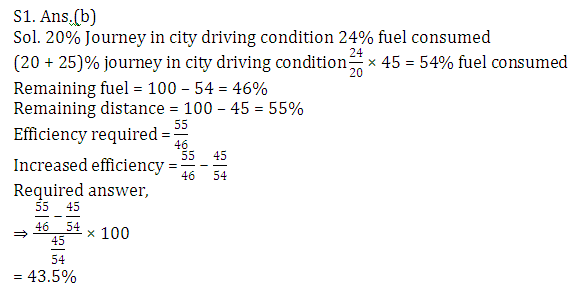
Q1. Samuel, a motorist uses 24% of his fuel in covering the first 20% of his total journey (in city driving conditions). If he knows that he has to cover another 25% of his total journey in city driving conditions, what should be the minimum percentage increase in the fuel efficiency for non-city driving over the city driving fuel efficiency, so that he is just able to cover his entire journey without having to refuel? (Approximately)
(a) 39.2%
(b) 43.5%
(c) 45.6%
(d) 41.2%
(e) None of these

Q2. A 14.4 kg gas cylinder runs for 104 hours when the smaller burner on the gas stove is fully opened while it runs for 80 hours when the larger burner on the gas stove is fully opened. Difference in the usage of gas per hour, between the smaller and the larger burner is what percent of the usage per hour of larger burner?
(a) 26.23%
(b) 30%
(c) 32.23%
(d) 23.07%
(e) None of these

Q3. Two people A and B start moving from P and Q that are 200 km apart, towards each other A is on a moped and B on foot. They meet at a point R when A gives B a lift to P and returns to his original path to reach Q. On reaching Q he finds that he has taken 2.6 times his normal time. B on the other hand realizes that he has saved 40 minutes over his normal travel time. Find the ratio of their speeds.
(a) 3 : 2
(b) 4 : 3
(c) 3 : 1
(d) None of these
(e) 4 : 1

Q4. A cyclist left point A for point B and travelled at the constant speed of 25 km/h. When he covered the distance of 8.33 km, he was overtaken by a car that left point A twelve minutes after the cyclist and travelled at a constant speed too. When the cyclist travelled another 30 km, he encountered the car returning from B. Assume that the car did not stop at point B. Find the distance between A and B.
(a) 39.5833 km
(b) 41.0833 km
(c) 60.833 km
(d) 43.33 km
(e) None of these

Q5. 4 men and 16 women can complete piece of work in 10 days. 10 children and 12 women can complete the same work in 12 days. 5 children and 6 men can complete the same work in 15 days. Then in how many days will thrice the work can be completed by 6 men, 8 women and 20 children?
(a) 16 days
(b) 24 days
(c) 32 days
(d) 20 days
(e) None of these

Q6. Two friends bought 2 different land at a price of 4000 and 6000 respectively. The value of first land increases 25% per year and second land increases at 5% per year. At the end of two year they exchange the land. Find profit % of gainer after exchange.
(a) 6.12%
(b) 5.84%
(c) 5.46%
(d) 6.24%
(e) None of these

Q7. On an average, two liters of milk and one liter of water are needed to be mixed to make 1 kg of Milk Shake of type A, and 3 litres of milk and 2 litres of water are needed to be mixed to make 1 kg of Milk Shake of type B. How many kilograms of each type of Milk Shake was manufactured if it is known that 130 liters of milk and 80 liters of water were used?
(a) 20 of type A and 30 of type B
(b) 30 of type A and 20 of type B
(c) 15 of type A and 30 of type B
(d) 30 of type A and 15 of type B
(e) None of these
Q8. A certain number of trucks were required to transport 60 tons of steel wire from the TISCO factory in Jamshedpur. However, it was found that since each truck could take 0.5 tons of cargo less, another 4 trucks were needed. How many trucks were initially planned to be used?
(a) 10
(b) 15
(c) 20
(d) 25
(e) 24
Q9. A fill pipe can fill a tank in 20 hours, a drain pipe can drain a tank in 30 hours. If a system of n pipes (fill pipes and drain pipes put together) can fill the tank in exactly 5 hours, which of the following are possible values of n (More than one option could be correct)?
(1)    32       (2)    54       (3)    29       (4)    40
(a) 1 and 2 only
(b) 1 and 3 only
(c) 2 and 4 only
(d) 2 and 3 only
(e) None of these

Q10. A car driver, driving in a fog, passes a pedestrian who was walking at the rate of 2 Km/h in the same direction. The pedestrian could see car for 6 minutes and it was visible to him up to a distance of 0.6  km. What was the speed of the car? 
(a) 15 Km/h 
(b) 30 Km/h 
(c) 20 Km/h 
(d) 8 Km/h 
(e) None of these

Q11. Manish, Rahul and Bharti have some stones with each of the. Five times the number of stones with Rahul equals seven times the number of stones with Manish while five times the number of stones with Manish equals seven times the number of stones withBharti. What is the minimum number of stones that can be there with all three of them put together?
(a) 113
(b) 109
(c) 93
(d) 97
(e) None of these

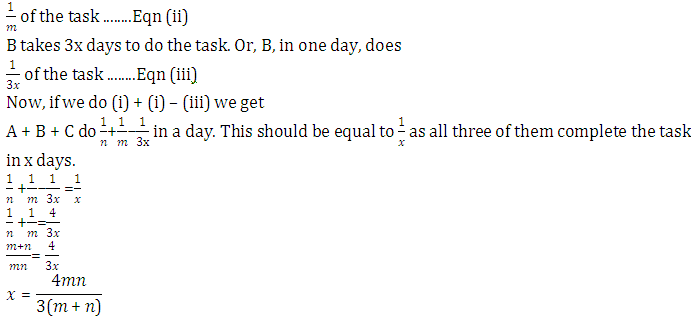
Q12. Consider three friends A, B and C who work at différent speeds. When the slowest two work together they take n days to finish a task. When the quickest two work together they take m days to finish a task. One of them, if he worked alone would take thrice as much time as it would take when all three work together. How much time would it take if all three worked together?


Q13. A shopkeeper defrauds both the dealer and the customer by measuring weights incorrectly. When he is purchasing items from the dealer, he takes 20% more then the indicated weight and when he is selling them to the customer, he gives 20% less than the indicated weight.If the price that the shopkeeper charges his customer is the same as what the dealer charges the shopkeeper, then what profit percentage does the shopkeeper make? 
(a) 50%
(b) 30%
(c) 40%
(d) 60%
(e) None of these 

Q14. A and B enters into a partnership business with a capital of Rs. 20000 and Rs. 30000 respectively. They decided to share the profit in ratio as per capital invested but in the end of 1st year they divided the profit in 3 equal parts and both A and B take 1 part individually. Rest of the profit is lend to C for a year at an interest rate of 50/3% Per year. At the end of 2nd year A received Rs 7000 from C then find the total profit at the end of 1st year.
(a) 84000
(b) 90000
(c) 60000
(d) 78000
(e) None of these

Q15. The Maximum Retail Price (MRP) of a product is 55% above its manufacturing cost. The product is sold through a retailer, who earns 23% profit on his purchase price. What is the profit percentage (expressed in nearest integer) for the manufacturer who sells his product to the retailer? The retailer gives 10% discount on MRP.
(a) 31%
(b) 22%
(c) 15%
(d) 13%
(e) 11%


It might seem as the greatest of the challenge after English Section’s surprises but yet this one can easily be dealt with. You just need correct practice and hardwire your brain to quickly make decisions of what to attempt and what to leave. Practice with these new pattern reasoning question for IBPS EXAM.
Directions (1-5): Study the given information carefully and answer the given questions.An input-output is given in different steps. Some mathematical operations are done in each step. No mathematical operation is repeated in next step but it can be repeated with some other mathematical operation (as multiplication can be used with subtraction in step 1 and same can be used with addition in step 2)


As per the rules followed in the steps given above, find out in each of the following questions the appropriate step for the given input.

Q1. Find the addition of the three numbers obtained in step I?
(a) 101
(b) 100
(c) 102
(d) 103
(e) None of these

Q2. Find the multiplication of two numbers obtained in Step III?
(a) 180
(b) 160
(c) 154
(d) 175
(e) None of these

Q3. Find the difference between the two numbers obtained in Step II?
(a) 6
(b) 4
(c) 5
(d) 8
(e) None of these

Q4. Find the square of number which is obtained in Step IV??
(a) 324
(b) 625
(c) 196
(d) 125
(e) 361

Q5. If digit is exchanged within the each block then find the multiplication of two new numbers obtained in step III?
(a) 171
(b) 154
(c) 1054
(d) 1071
(e) None of these

Solution (1-5):


S1. Ans. (a)
Sol. Addition of number in Step I is= 35+13+53=101

S2. Ans. (a)
Sol. Multiplication of number in Step III- 12*15=180

S3. Ans. (d)
Sol. Difference between the number obtained in Step II-  43-35=8

S4. Ans. (a)
Sol.  Number obtained in Step IV- is 18
        Square of 18 is 324.

S5. Ans. (d)
Sol.  Numbers obtained in Step III- 12, 15
         If digits are exchanged then new numbers are 21, 51
         Multiplication of new number= 21*51=1071


Directions (6-10): Study the information and answer the following questions:In a certain code language
"first set copper bright" is coded as “8QG 5NI 5DG 19HG”
"cherish relic for the" is coded as "8GV 15NI 9DX 19GS"
"jewesh leader joseph comment " is coded as "14NG 16NS 5DI 19DS"

Q6. What is the code for ‘hopeful'?
(a) 21MO
(b) 21NZ
(c) 22NO
(d) 21NO
(e) None of these.

Q7. What is the code for “traditional”?
(a) 2QO
(b) 1QQ
(c) 1OO
(d) 1QO
(e) None of these.

Q8. Which may be the possible code for "crowned"?
(a) 5QW
(b) 5OW
(c) 5QX
(d) 6QW
(e) None of these.

Q9. What is the code for 'replica'?
(a) 3DZ
(b) 4DZ
(c) 3CZ
(d) 3DX
(e) None of these.

Q10. What is the code for "religious"?
(a) 22DH
(b) 21DH
(c) 21CH
(d) 21DI
(e) None of these.

Solution (6-10):
These are the latest pattern of coding-decoding questions. In these questions we are applying following concept:-
 
S6. Ans. (d)
Sol.  

S7. Ans. (d)
Sol. 

S8. Ans. (a)
Sol. 

S9. Ans. (a)
Sol. 

S10. Ans. (b)
Sol.

Directions (11-15): Study the following information and answer the given questions:
Nine teachers – P, Q, R, S, T, U, V, W, and X live on separate floors of a 9-floor building. Ground floor is numbered 1, first floor is numbered 2 and so on until the topmost floor is numbered 9. Each one of these teach different subjects viz. Computer, Economics, Commerce, Accounts, Biology, English, Physics, Art, and Music but not necessarily in the same order. Only five teachers live above the floors on which P lives. Only one teacher lives between P and the one who teaches English. U lives immediately below the one who teaches Economics. The one who teaches Economics lives on an even numbered floor. Only three teachers live between the one who teaches English and the one who teaches Commerce. T lives immediately above R. T does not teach Commerce. Only two teachers live between Q and the one who teaches Biology. The one who teaches Biology live below the floor on which Q lives. W teaches Art and lives on floor no. 8. The one who teaches Computer does not live immediately above or immediately below Q. S does not live immediately above or immediately below P. X teaches Music and lives immediately above W. V does not teach Accounts.

Q11. Who among following lives on ground floor (Floor number one)?
(a)P
(b)V
(c) T
(d)R
(e)U

Q12.Who amongst the following lives on floor no. 3?
(a) P
(b) U
(c) R
(d) V
(e) T

Q13.Who lives on the floor immediately above V?
(a) P
(b) Q
(c) S
(d) V
(e) U

Q14.S teaches which of the following subject? 
(a) Accounts
(b) English
(c) Commerce
(d) Biology
(e) None of these

Q15.How many teacher/teachers live between the floors on which S and the one who teaches English? 
(a) None
(b) Two
(c) One
(d) More than three
(e) Three

Solution (11-15):

S11. Ans.(d)
Sol.

S12. Ans.(b)
Sol.

S13. Ans.(b)
Sol.

S14. Ans.(a)
Sol.

S15. Ans.(d)
Sol.

Popular Posts